Picture a family planning a trip to Moab. Five years ago, they’d Google “best rafting trip near Moab,” scan a page of blue links, open a few tabs, and compare. Today, a growing share of those travelers ask ChatGPT or Gemini instead — and get back a short, confident answer naming two or three specific outfitters.
If your company is one of them, great. If it isn’t, that family books with someone else, and you never see it happen. No lost click in your analytics. No drop in your rankings. Just a booking that quietly went elsewhere.
This is the part of search that traditional SEO tools can’t see, and it’s growing.
Why your rank tracker misses this entirely
Traditional Search Engine Optimization is built around a simple model: a search returns a list of links, and your job is to be near the top of that list. Rank trackers, keyword tools, and SERP reports all measure your position in it.
AI assistants don’t return a list. They return a recommendation — a synthesized answer that names a handful of businesses and often summarizes why. There’s no “position 7” to claw your way up from. You’re either in the answer or you’re invisible, and the assistant may have pulled its reasoning from review sites, blog posts, and pages you’ve never optimized.
That means an operator can have solid Google rankings and still be absent from the answers travelers actually read. The two don’t move together, and most operators have no way to check.
What "being recommended by AI" actually means
It helps to be concrete. When someone asks an AI assistant for “the best Sedona jeep tour,” a few things determine whether you show up:
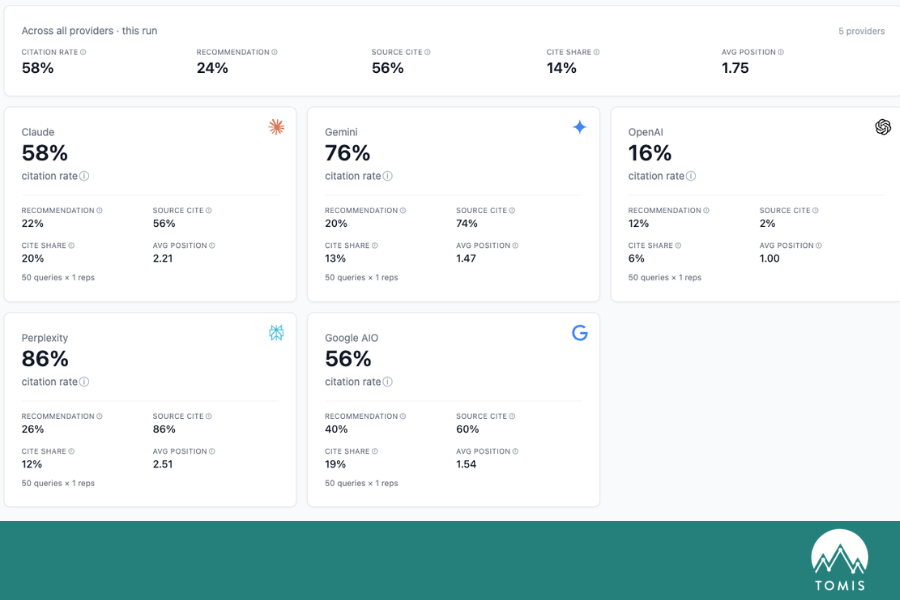
- Whether the assistant cites you at all when answering the real questions your buyers ask — not just your brand name, but the trip types, locations, and comparisons that matter.
- The “Gold Standard” of Explicit Recommendation. There is a massive difference between an AI simply citing you as a data source and the AI actively pitching you. The holy grail is when the model explicitly recommends your brand name as the premiere provider for a specific experience—telling the user, “For the best whitewater rafting in Moab, you should book with [Your Brand].”
- How often you’re cited and recommended versus competitors. Assistants answer these questions thousands of times a day, and their responses vary. What counts is your share of those top-tier recommendations over time, not a single lucky screenshot.
- Whether the assistant can even read your site. AI crawlers have to fetch your pages to learn about you. If they’re blocked or rate-limited — which happens more often than you’d think, and is usually fixable — you’re leaving the decision to third-party sources.
One more thing worth knowing: assistants don’t answer from thin air. They run their own fan-out queries to build an answer. If nobody has published a good page answering “which Moab rafting trips are safe for a 6-year-old,” the assistant works from whatever’s closest — and that’s often not you. The TOMIS ai.vis tool not only outlines content gaps but also identifies those exact fan-out queries.
What tour operators can actually do about AI visibility
The good news: AI visibility is measurable and improvable, the same way SEO was. Three steps.
- Measure where you stand — across all five surfaces. Travelers don’t use just one assistant. ChatGPT, Perplexity, Gemini, Claude, and Google’s AI Overviews all answer travel questions, and they answer differently. Run your real buyer questions across all five, repeatedly, and track whether you’re cited, how often versus competitors, and how that trends. A one-time spot check tells you almost nothing; the answers change.
- Find your content gaps — and fill them. Look at the fan-out queries the assistants searched to build their answers, and find the ones where you weren’t cited. Those are your content gaps. Each one is a specific page or post you could publish: the topic, the questions it should answer, the searches it should win. This is the “so what do we do about it” step, and it’s where most of the improvement comes from.
- Tie it to revenue in your own analytics. AI visibility should show up as real sessions and real online bookings in your Google Analytics. Track the traffic and revenue each assistant sends, month over month. Two honest caveats: GA4 logs clicks from Google’s AI Overviews as regular organic traffic, so those can’t be broken out separately, and revenue figures capture online click-through purchases — not the guest who read an AI answer and then called you. The numbers you can see are still the clearest signal available that this channel is producing.
How TOMIS does this
This is exactly what we built ai.vis to do. It runs your buyer questions across the five major AI surfaces and scores your citation share against competitors; clusters the questions where you’re not cited into prioritized content recommendations with ready-to-use briefs; pulls your own GA4 data to show the sessions and online revenue each assistant drove; and monitors which AI crawlers are reaching your site — and whether anything’s blocking them.
It’s built specifically for tour and activity operators: your competitor set, your activity types, your locations. Not a generic brand-monitoring tool with a travel skin on it.
And it reports honestly. If the data has a limit, we say so. In this industry, trust beats hype.
See if AI recommends your tours
The travelers asking AI for trip recommendations this season are booking with somebody. The only question is whether you can see the answer they’re getting.
See if AI recommends your tours — talk to TOMIS.